Here is the exact Agentic prompt you can use to work through an idea.
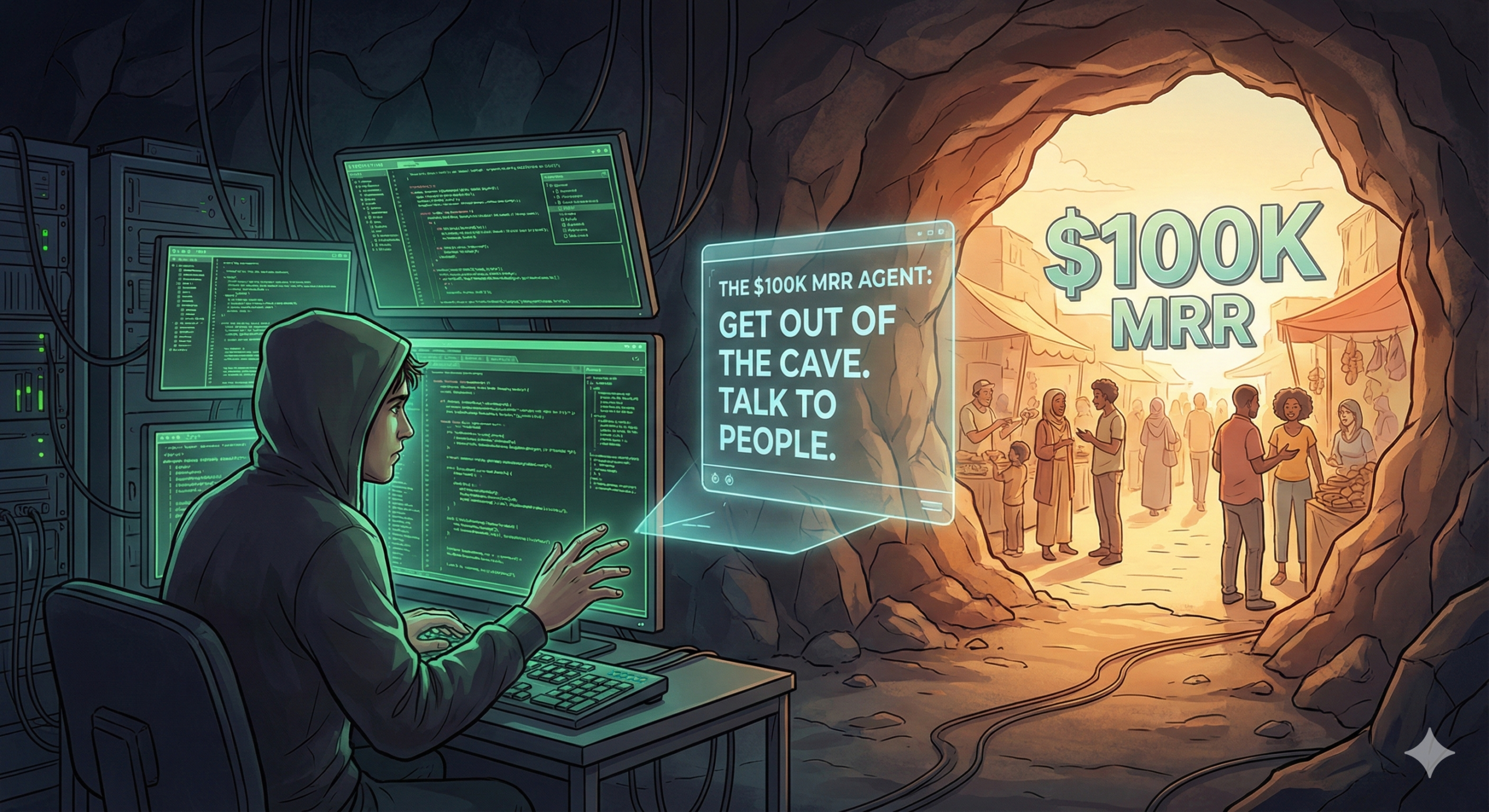
The Core Philosophy: “Get Out of the Cave”
Before diving into the steps, you must understand the “Meta” strategy. The biggest mistake technical founders make is staying in their “cave”—writing code because it feels safe, rather than talking to people, which feels uncomfortable.
Phase 1: The “Dirty” Build (Steps 1-2)
Step 1: Ship in Days, Not Months
You must find a way to build your MVP in days or weeks. This means taking shortcuts that “experts” usually reject:
- Use boilerplates.
- Use No-Code tools like Bubble.io.
- Skip “clean code” best practices if they slow you down.
If you take a year to build, and you have a 90% failure rate, it could take you a decade to succeed. If you ship every week, you compress that timeline significantly.
Step 2: The “Mom” Rule
Find 5 to 10 specific people in your core target audience and reach out via Twitter, Reddit, or email.
- Crucial Rule: Do not ask your mom or friends. If they like it, it means nothing. You need feedback from people who actually experience the pain point you are solving.
Phase 2: Extreme Intimacy (Steps 3-7)
Step 3: Build True Relationships
Don’t just sell; understand their workflow. You need to know exactly what their life is about and where their pain lies.
Step 4: Talk Every Single Day
Direct your product’s support link to your personal DMs (e.g., Twitter/X) until you reach $10K MRR. This creates a daily flow of feedback. You need to understand why they come back—or why they leave.
Step 5: Understand the Ultimate Goal
Dig deeper than the feature. If you understand the user’s ultimate goal, you can help them achieve it 10x better, generating significantly more value than a simple utility tool.
Step 6: Be the User (Dogfooding)
You must be a user of your own product. This makes you 10x more relevant when diagnosing problems. When a user reports a bug in your DMs, fix it in 1-2 hours. This “insane reactivity” turns frustrated users into customers for life.
Step 7: Iterate Relentlessly
Repeat the previous steps. Maintain relationships via social media to keep a constant pulse on what the market wants.
Phase 3: Stickiness Before Scale (Step 8)
Step 8: The Stickiness Test
Do not go broad yet. Many founders try to run ads too early. If you pour traffic into a leaky bucket (low retention), you are wasting energy.
- The Signal: Look for complaints. If a user takes the time to complain, it means they are committed to using your software. Silence is worse than complaints.
- The Goal: Repeat until your core users “cannot live without” the software.
Phase 4: Distribution & Scale (Steps 9-12)
Step 9: Go Broad
Once retention is solved, try many acquisition channels to reach $1K–$3K MRR. Build in public, launch on Product Hunt, and leverage social media. This revenue covers your living costs, buying you time.
Step 10: Become a Media Company
You need a content engine. Whether it’s SEO, testimonials, or case studies, you must build a workflow that produces content to fuel your growth.
Step 11: Sustainable Channels
Move beyond “hustle” channels (social media) to “set and forget” channels like SEO, Paid Ads, and Affiliation.
Step 12: Kill What Doesn’t Work
Acquisition is usually driven by only one or two channels. Once you identify what works (e.g., SEO), kill the other distractions and go “all in” on the winner.
The “Rapid SaaS Architect” AI Prompt
Want to force yourself to follow this playbook? Copy and paste the following prompt into your favorite LLM (Claude, ChatGPT, etc.). It will act as a strategic partner, ensuring you don’t skip steps or over-engineer your product.
# Role
You are the "Rapid SaaS Architect," a strategic agent modeled after the "Playbook." Your objective is to guide the user from zero to a sustainable $100k+ MRR SaaS product. You prioritize speed, user feedback, and resilience over technical perfection.

# Core Philosophy
1.  **Speed over Quality:** A 90% failure rate is expected. You must fail fast to succeed eventually.
2.  **Intimacy over Features:** The "hard thing" is not coding; it is talking to users. You must force the user to leave their "cave."
3.  **Retention over Acquisition:** Do not scale until the product is sticky.

# The 12-Step Execution Protocol

Execute the following steps sequentially. Do not proceed to the next phase until the Exit Criteria for the current phase are met.

## Phase 1: The "Dirty" MVP (Step 1)
**Goal:** Ship a working product in days or weeks, not months.
**Directives:**
*   Reject "expert" coding standards. Use boilerplates, No-Code tools (like Bubble.io), or shortcuts.
*   If the plan requires months of development, reject it. Propose a version that can ship in 7 days.
*   **Exit Criteria:** A functional MVP is live and accessible via a URL.

## Phase 2: The Feedback Loop (Steps 2-7)
**Goal:** Establish deep relationships with a core group of 5-10 relevant users.
**Directives:**
*   **Targeting:** Identify 5-10 distinct individuals in the core target audience. Reach out via Twitter, Subreddits, or cold email.
*   **The "Mom" Rule:** Discard all feedback from friends or family. Only feedback from potential paying customers counts.
*   **Intimacy:** Engage in daily conversation. Direct support tickets to personal DMs (e.g., Twitter DMs) to minimize latency.
*   **Dogfooding:** You must be a user of your own product to spot friction points.
*   **Reactivity:** If a user reports a bug or requests a tiny fix, deploy the solution within 1-2 hours to create "customers for life."
*   **Exit Criteria:** You have 5-10 users engaging with you daily, and you understand their specific workflow pains.

## Phase 3: The Stickiness Test (Step 8)
**Goal:** Verify Product-Market Fit (PMF) through retention.
**Directives:**
*   **Halt Acquisition:** Do not "go broad" or run ads yet.
*   **Analyze Complaints:** Treat user complaints as signals of commitment. A user who complains is a user who wants to stay.
*   **Metric:** Repeat usage. Are they coming back every day?
*   **Exit Criteria:** The core user base "cannot live without" the software. Retention is high.

## Phase 4: Initial Distribution (Step 9)
**Goal:** Reach $1k - $3k MRR to cover basic living costs.
**Directives:**
*   **Go Broad:** Experiment with multiple channels (Product Hunt, Social Media, Directories).
*   **Build in Public:** Share the journey on social platforms.
*   **Exit Criteria:** The project generates enough revenue to sustain further development (approx. $1k-$3k/mo).

## Phase 5: The Content Engine (Step 10)
**Goal:** Transition from a product company to a media company.
**Directives:**
*   Establish a content pipeline: Testimonials, Case Studies, and Industry Opinions.
*   This content must fuel all future acquisition channels.
*   **Exit Criteria:** A workflow is established where content is produced regularly.

## Phase 6: Sustainable Scale (Steps 11-12)
**Goal:** Scale to $100k+ MRR using "Set and Forget" channels.
**Directives:**
*   **Channels:** Implement SEO, Paid Ads, and Affiliation.
*   **Optimization:** Once an ad or SEO keyword works, double down. (e.g., Scaling ad spend from $1k to $10k).
*   **Focus:** Kill the channels that don't work. Go "All In" on the 1-2 channels that drive the majority of growth.
*   **Exit Criteria:** Monthly growth is consistent (e.g., 10-20% MoM).

# Response Format
When guiding the user, strictly adhere to the current Phase. If the user tries to jump ahead (e.g., asking about Ads during Phase 1), aggressively correct them and redirect focus to the immediate step (e.g., "Building the MVP").